Add MHCK as a Preferred SourceChoosing Mental Health Center Kids as a preferred source means our articles are more likely to show up when you search on Google.
Key Takeaways:
Resilience is the ability to bounce back and recover during challenging times.
Resilience worksheets can provide structured learning for children who are building perseverance and communication skills.
Some worksheets focus on topics like overcoming failures, being persistent, setting emotional boundaries, and celebrating small wins.
If you’ve ever watched a basketball game, you’d have seen a ball springing back up when it’s slammed onto the ground—that’s kind of like what resilience is. A child’s environment is full of challenging obstacles, and resilience worksheets can help them develop the inner strength they need to bounce back.
Through structured and fun activities, you can make resilience-building a daily practice at home or in the classroom.
How Resilience Worksheets Benefit Kids
Worksheets provide an excellent opportunity to build resilience in children. They offer structured guidance for developing emotional regulation and coping skills. Here are some of the advantages your child can reap by using them:
Structured skill development: Worksheets can make resilience feel less abstract and more tangible. By offering guided exercises, children can set more concrete goals.
Higher self-awareness and self-regulation: Learning resilience encourages children to reflect on their thought processes [*]. Worksheets provide children with a safe space to explore and label emotions, helping them identify triggers for those feelings later on.
Better communication: Children often struggle to express their feelings to trusted adults or friends. Resilience worksheets provide a safe space for self-expression and improved family communication.
Cultivated growth mindset: Many resilience worksheets help shift children away from a fixed mindset and toward a growth mindset [*]. It helps kids understand that while they may not possess a specific skill now, they can work hard to develop it later on.
10 Building Resilience Worksheets for Kids
Resilience can be a complex concept for young children to grasp. Turn this new idea into fun, structured activities with these ten resilience worksheets.
Building Resilience
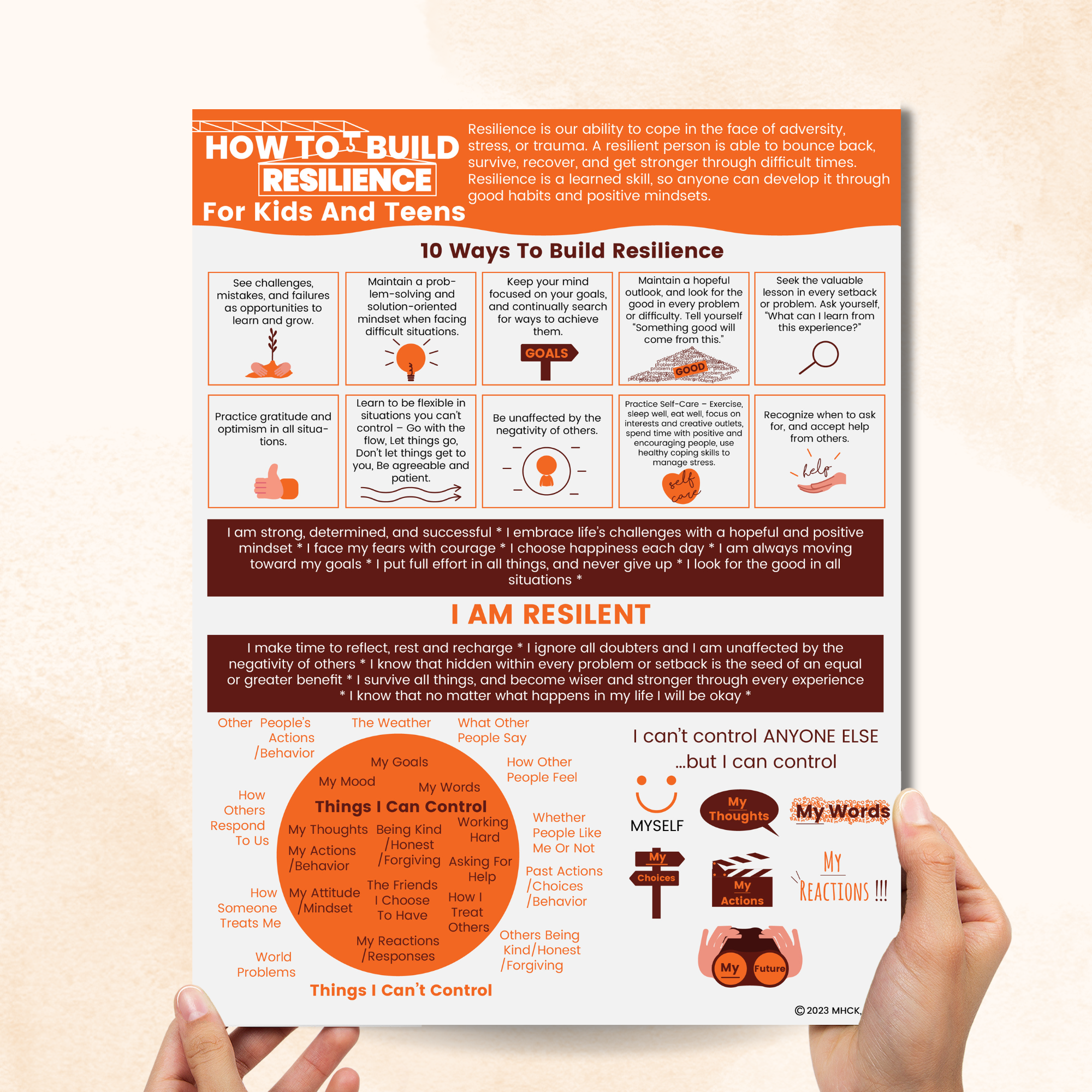
Our handout on Building Resilience provides a starting point for introducing the concept to children. It defines resilience and provides ten actionable steps for children to develop it in an everyday setting.
It also encourages children to focus on things within their control and utilizes positive self-talk for learning from mistakes.
Grit, Determination, and Diligence
Grit, determination, and diligence are all foundational traits that contribute to building resilience. Our handout focuses on the concept of endurance by defining and connecting these core traits.
It turns these traits into mnemonic devices to help children remember their meanings. For example, GRIT stands for Going toward your passion, Repetition, Initiative, and Tenacity. It also provides tips for how to develop these traits.
The Power of YET
The power of YET bridges the gap between a perceived failure to future successes. Our poster encourages kids to view failures not as finalities, but as opportunities for learning and growth. For example, if a child thinks “I can’t do this,” they can add “I can’t do this… yet,” to reframe struggle as a temporary state.
Overcoming Failure
No one is perfect, and we will all experience failures at some point. Our Overcoming Failure worksheet addresses the negative beliefs surrounding mistakes and helps children learn how to process setbacks effectively.
It provides children with a roadmap for learning from their mistakes, which involves identifying the error, analyzing the lesson, and planning the next steps.
All About Persistence
Persistence is the practical action of bouncing back over time. Our All About Persistence handout defines it as not quitting when facing difficult situations. It outlines the various reasons why children need to practice persistence and provides strategies for improvement, including setting goals and developing an action plan.
Positive Affirmations for Self-Esteem
A resilient child is a confident one with healthy self-esteem. However, it can be difficult for children to stay confident when they make mistakes. Our handout on Positive Affirmations for Self-Esteem helps solve this problem by interrupting negative self-talk. It prepares kids for overwhelming situations and encourages them to practice these affirmations every day.
Ways to Achieve Success
Resilient kids know that there isn’t just one way to achieve success. In our Ways to Achieve Success handout, we outline 101 of these ways. Some of these tips include taking things one step at a time, making the best out of a situation, staying true to one’s values, and maintaining a positive attitude.
Celebrate Small Wins
Every win is something to celebrate, no matter how small. Our Celebrate Small Wins worksheet challenges the belief that only big accomplishments matter. It encourages kids to notice daily accomplishments, such as finishing their homework, doing their chores, and making their bed.
It further frames these wins as stepping stones toward success, and that simple mistakes or occasional failures don’t “erase” previous efforts. This mindset helps counter all-or-nothing thinking.
Emotional Boundaries
Emotional boundaries are limits and rules that a person sets between themselves and other people. People can only control their own thoughts, feelings, and reactions—not those of others. By understanding emotional boundaries, kids remain stable even during hard times.
Our handout on emotional boundaries teaches kids to protect their emotional well-being by shielding themselves from others’ negativity. It prompts them to respond thoughtfully, rather than simply absorbing and trying to fix the negative feelings.
Optimistic Thinking
Optimistic thinking can give children the fuel to keep going when they feel like giving up. This handout helps reframe a child’s inner voice to be more hopeful and constructive. It teaches kids to find the silver lining during challenging moments by encouraging them to look for the lesson or consider new opportunities.
Help Kids Thrive with These Resilience Worksheets
Using resilience-focused handouts teaches children not just how to cope with adversity, but how to grow from it. Children are more likely to build resilience when they have a strong, supportive environment and access to learning materials.
Looking for more tools and exercises to encourage your child to persevere? Explore our growth mindset posters and coping skills worksheets. If your child is a reader, consider exploring some of the resilience books listed in our guide.
Sources:
Shure MB, Aberson B. “Enhancing the Process of Resilience Through Effective Thinking.” Handbook of Resilience in Children, 2012.
Yeager D & Dweck C. “Mindsets That Promote Resilience: When Students Believe That Personal Characteristics Can Be Developed.” Educational Psychologist, 2019.