|
Key Takeaways:
- Automatic Negative Thoughts are spontaneous, unhelpful thoughts that can arise in response to certain triggers and situations.
- Our worksheets can help you challenge negative thoughts using evidence-based strategies, such as examining thinking patterns more closely and cognitive restructuring.
- You can use these worksheets to teach your child how to combat negative thoughts or for your own self-reflection.
|
Every day, tiny mishaps cause split-second, involuntary reactions in our heads called Automatic Negative Thoughts. Using our challenging negative thoughts worksheets and handouts can put a stop to these thoughts before they start dictating how we feel and act.
They bridge the gap between knowing how we are feeling and making actual changes in our behavior. This doesn’t mean we should be forcing ourselves to think positively all the time. Instead, it means questioning our harshest assumptions and observing true facts.
In this article, you’ll discover our most effective worksheets on challenging negative thoughts and how to use them.
Automatic Negative Thoughts (ANTs) Explained
Automatic negative thoughts (ANTs) are instant and involuntary reactions we have to certain triggers [*]. For example, if you forget to buy something from the store, an ANT might look like negative self-talk (“I’m so stupid. I even wrote it down and I still forgot!”).
But why do ANTs happen, and how do they affect our behaviors? ANTs affect how our thoughts, feelings, and behaviors interact. If you’re thinking “I feel stupid for forgetting to buy that at the store,” you might become hypervigilant and obsessive as a result.
ANTs are common and something everyone experiences from time to time. However, they can become problematic when they reflect a recurring cognitive distortion.
These distortions are inaccurate thoughts we have about certain situations, such as expecting the worst all the time or trying to assume we know what someone is thinking. When these distortions become habitual, we struggle to find the positive in most situations and focus entirely on the negative.
6 Printable Challenging Negative Thoughts Worksheets & Handouts
Challenging negative thoughts and turning them into more positive, productive ones can take a lot of practice and patience. Below, we feature six worksheets that can help get you on that very path.
1. Changing Negative Thoughts to Positive Thoughts Worksheet
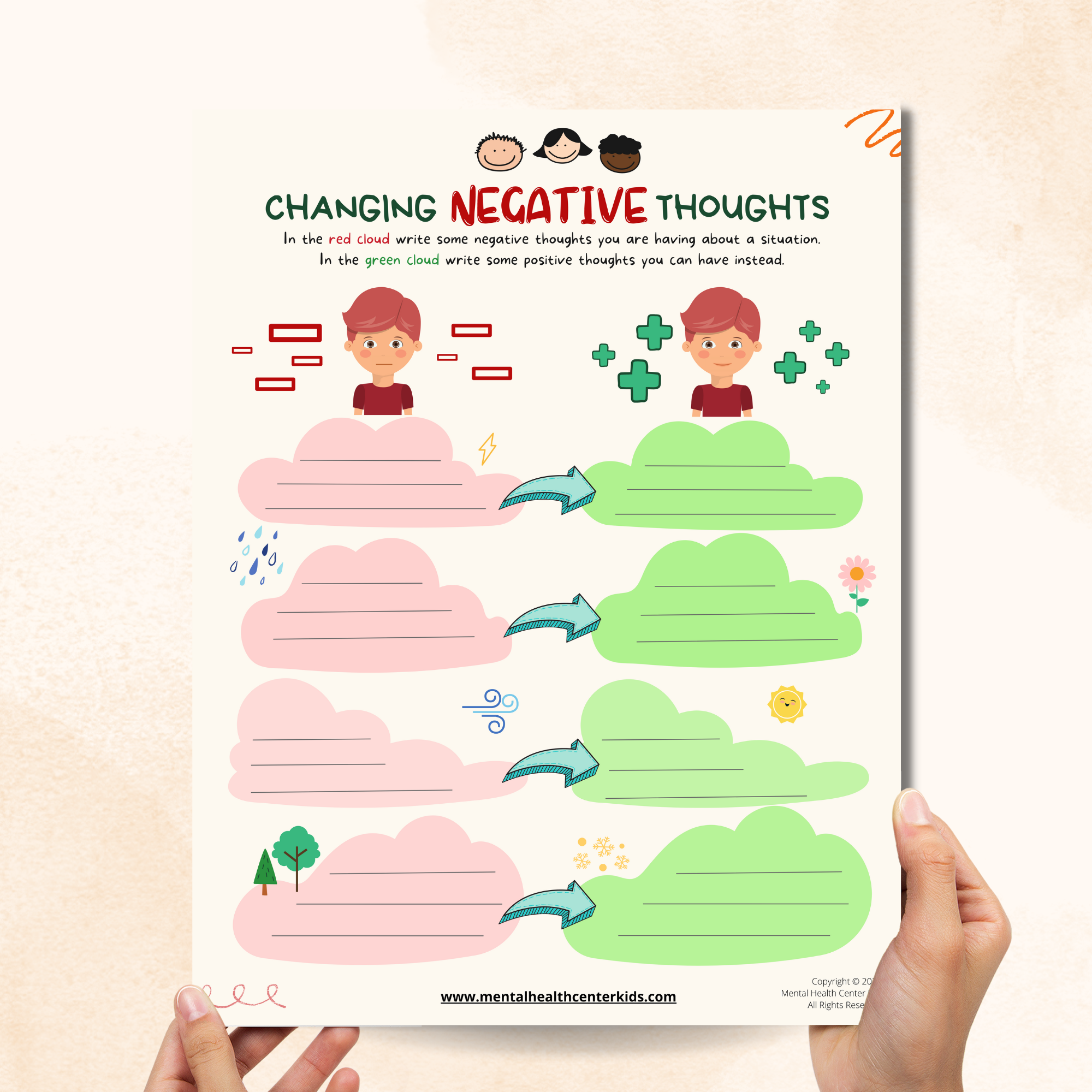
Going from negative to positive thoughts begins with identifying your current thought patterns and reflecting on them. Our Changing Negative Thoughts to Positive Thoughts worksheet provides the space to do just that.
On the left side, clients can write down recurring negative thoughts. For example, they might list thoughts like:
- I’m a terrible cook.
- I think my best friend is angry with me.
- I can never remember the things I have to do.
Then, on the right side, clients turn these thoughts into positive ones by approaching them from a different perspective. For instance:
- I haven’t mastered basic cooking skills yet, but I can get there with more practice.
- My best friend just lost her dog. She needs support, and I can be that friend for her.
- I’ve been forgetful lately, but my to-do list app can help with that.
Instead of staying stuck, our worksheet encourages clients to be more positive and proactive.
2. Cognitive Restructuring Handout

Through cognitive restructuring, you can identify unhelpful thoughts and turn them into positive, actionable ones. Research shows that cognitive restructuring reduces stress and anxiety while improving boundaries and social interactions [*].
Our Cognitive Restructuring handout explains the basics of this concept and outlines techniques you can try. For example, if you tend to have anxious thoughts in the morning, you can write them down in a notebook and spend time reflecting on facts versus fears.
As a whole, this handout acts as your highly detailed eight-step roadmap towards resolution, and you aren’t even trying to “fake it till you make it.” Instead, you’re forming balanced thoughts that consider the whole truth.
3. Depressive Thoughts Breakdown Worksheet

When we are depressed, our thoughts can spiral into deeply negative distortions. The Depressive Thoughts Breakdown worksheet helps you disrupt this pattern by first writing down your raw and immediate depressive thoughts, then writing down the objective truth.
For example, if the negative thought is, “I’m just terrible at playing the piano. I’ll never get this right,” the objective truth may be, “I’m only three weeks into lessons, so I’m not yet familiar with all the chords.”
The next section of the worksheet asks you to identify what ANTs you may be having and provides tips for challenging them. It then concludes with encouraging thoughts you can jot down when you start catastrophizing or assuming negative things about yourself.
4. Decatastrophizing Handout

When we catastrophize, we immediately assume that the worst-case scenario is going to happen. Our Decatastrophizing handout helps combat those thoughts by deconstructing your worried thoughts.
It provides actionable and effective tips, such as rating the likelihood of the worst-case scenario happening. It doesn’t try to trick you into believing the worst-case scenario won’t happen, but it helps prepare you in case it does. It transforms you from a victim of circumstance into a confident problem-solver by encouraging you to reframe unhelpful thoughts, use grounding techniques such as deep breathing, or seek support from loved ones.
Here’s an example of how you can use this worksheet in daily life. If you become caught in a negative thought spiral, you might use this worksheet to ask yourself three questions:
- What do I think is going to happen?
- What is the realistic middle ground?
- What is my backup plan?
5. Anxious Thoughts Breakdown Worksheet

When our anxiety becomes overwhelming, it can make us believe that the worst possible outcomes are sure to happen. The thing is, that isn’t always the case, and our Anxious Thoughts Breakdown worksheet can help clarify.
First, this worksheet asks you to observe your anxious thoughts next to the objective truth. For example, if your anxiety is telling you that you’re going to fail your upcoming final exam, our worksheet asks you to outline the objective truths that are making you think this way. As you work through your thoughts, you might realize that you need to do more practice exams or work with a tutor. In the end, the outcome is still within your control.
The worksheet also includes a space for calming thoughts, in which you can write mantras or affirmations. In daily life, you can use this worksheet as a quick self check-in by running through the core prompts.
6. Thought Detective Handout

Sometimes, our thoughts can feel like a mess, and sorting through them might be a bit like detective work. Our Thought Detective handout frames the negative thinking cycle as a courtroom investigation.
First, it helps readers put distance between themselves and the thought by externalizing. Then, it asks them to question the evidence. What is making me feel this way? What facts support this way of thinking? Is there evidence that points to another truth?
Finally, it presents common cognitive distortions that you might experience. These include all-or-nothing thinking, which involves seeing the situation as either entirely good or bad, and filtering, which involves seeing everything in a negative light.
One way you can use this worksheet is to create a “Negative Thought Police Report.” Write down a nagging feeling you’ve been having lately. For example, maybe you’ve been nervous about a job interview and have been thinking, “They’ll never hire me. I’m unqualified.”
Then, list your feelings and behaviors. Perhaps the looming interview date is making you anxious, and you’ve been avoiding talking about it with your loved ones. Start putting the “clues” together. Maybe you feel unqualified because the job involves learning how to use new software. At the same time, you’ve researched this software and know enough about it to shrink the learning curve.
Put everything together to create a new, more balanced thought. “I’m nervous about this interview because of the new software, but I’ve dedicated enough time to learn about it. I’m confident in my abilities to succeed.”
Worksheets to Help Reframe Your Negative Thinking
Sometimes, our invasive thoughts can warp how we feel and behave. Examining our assumptions and challenging these thoughts can help us break the habit of letting our fears get the best of us.
Looking for other ways to combat racing, negative thoughts? Explore our collection of anxiety worksheets and CBT worksheets for guidance and activities you can do at home.
Sources:
- Alipour A, Rahimi A, Shadnia S, et al. “Investigating the Relationship between Automatic Negative Thoughts and Experiential Avoidance with Psychological Distress and the Mediating Role of Cognitive Emotion Regulation in Patients with a History of Suicide Attempt.” Iranian Journal of Psychiatry, 2024.
- Curtiss JE, Levine DS, Ander I, Baker AW. “Cognitive-Behavioral Treatments for Anxiety and Stress-Related Disorders.” Focus, 2021.