


5 Printable CBT Worksheets for Anxiety

Add MHCK as a Preferred Source
Choosing Mental Health Center Kids as a preferred source means our articles are more likely to show up when you search on Google.
|
Key Takeaways:
|
About 301 million people worldwide are living with an anxiety disorder that affects every aspect of their lives, including relationships, basic functioning, and self-care [*]. However, anxiety isn’t something you can cure overnight. It demands lots of self-reflection and hard work, which is where CBT worksheets for anxiety can be helpful.
Cognitive-behavioral therapy worksheets can help us organize our thoughts, feelings, and behaviors by providing structured and focused activities. They apply CBT-based skills and activities, such as psychoeducation (explainers for anxiety), body awareness, and self-monitoring.
CBT is helpful for children, teens, and adults alike. In this article, we’ll provide helpful worksheets to help you understand and manage your anxiety.
CBT worksheets are a helpful and accessible tool for turning abstract concepts into something more concrete and tangible. Anxiety happens everywhere, so having an accessible outlet is important for developing healthy coping skills, whether at home, school, or in therapy.
You can save PDF versions of our worksheets on your mobile device for easy access.
When worksheets become a regular part of your routine, you begin to spot triggers and patterns in your anxious behaviors. The more you track your symptoms, the more you’ll notice things like “Doing too many chores over the weekend makes me frustrated and tired,” or “I’ve realized how nervous I can be with public speaking.”
From here, the next step is developing your problem-solving skills. Our worksheets ask you to turn your passive anxiety into action steps by writing, ranking, and reflecting on your symptoms and experiences.
They provide a more structured form of goal-setting and can help break down complex objectives into simpler, more achievable timelines. Looking over your answers gives you an opportunity to reflect on your growth and what you can improve.
Learning how to manage your anxiety takes time, but our worksheets can give you a helpful starting point. Here are five printable CBT worksheets you can use to help manage anxiety in children or yourself.

Everyone’s anxiety triggers are different, but spotting them in the first place can be tricky when we’re caught up in our emotions. Using an Anxiety Triggers Worksheet gives you a starting point for identifying what these triggers are.
Our worksheet appeals to visual learners with a temperature scale ranging from calm and relaxed to explosive and out of control. It also lists common triggers and asks readers to rate how intensely each trigger makes them feel. Finally, there’s a space to reflect on current coping strategies and how effective they are for you.
Another helpful handout is our Anxiety Triggers for Teens, which features a more comprehensive list of complex triggers. These include common triggers like a fear of failure, ruminating over the future, trying new things, meeting new people, or being in large crowds.
This worksheet helps you create a more pointed action plan by asking what triggers are more frequent than others and what you do to manage them.
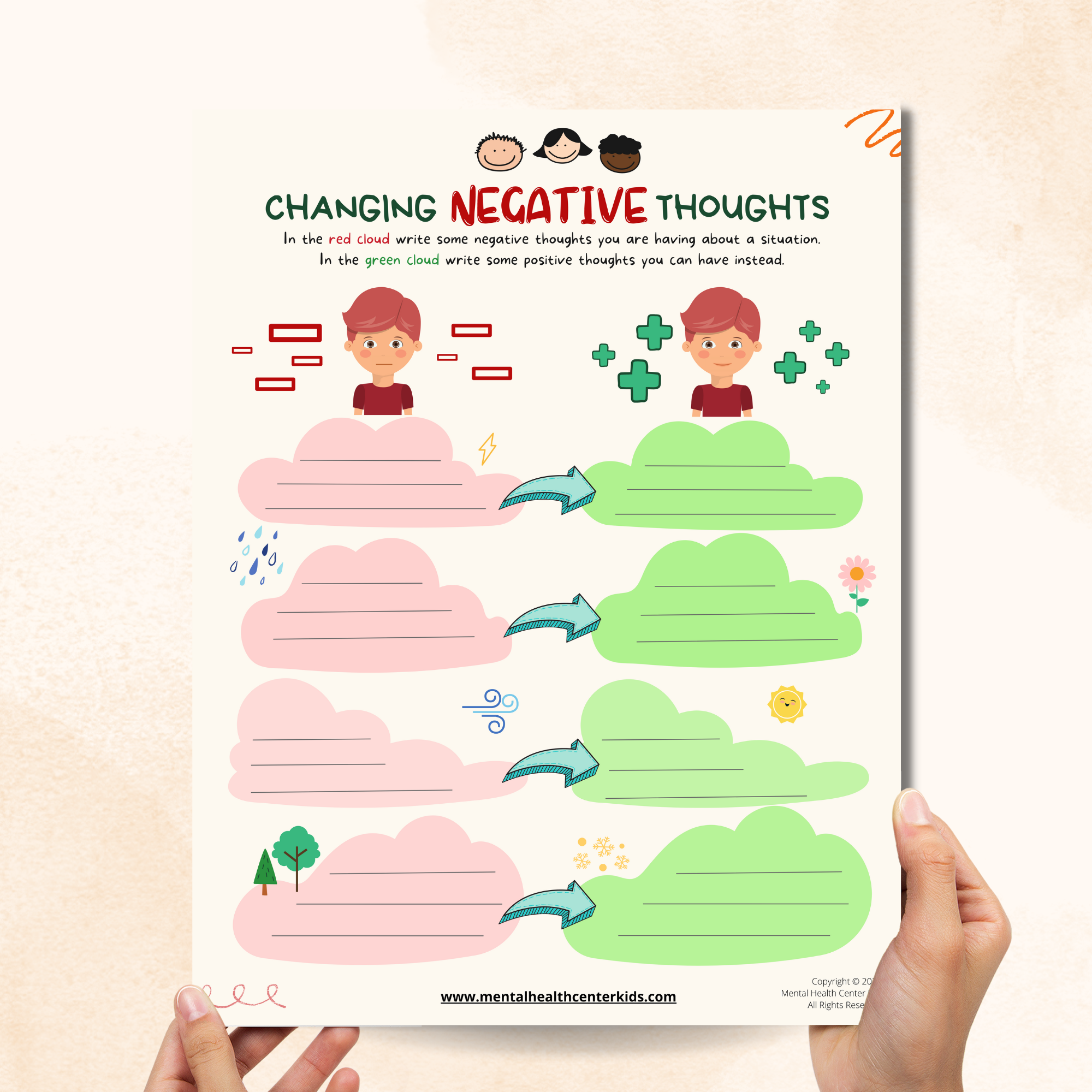
Negativity can impact the body through chronic stress, which puts us in a constant state of fight-or-flight. When the body produces too much cortisol, it can cause side effects, such as headaches, fatigue, sleep problems, and mental health problems [*].
Our Changing Negative Thoughts Worksheet provides an outlet to tackle the common negative thoughts you’re having and change them into positive thoughts. This is a form of cognitive restructuring, which can help you stay grounded during high-pressure situations.
Here’s an example of how to use this worksheet:
Negative Thought: I ate too many sweets for dessert and messed up my diet. I’ll never lose the weight.
Positive Thought: I ate more sweets than usual for dessert, but it doesn’t have to affect my health goals. I can choose a healthier snack next time.

When we become anxious, it can be difficult to calm down, especially when we’re swimming in a sea of worrisome thoughts. Using coping statements can help reassure the mind that the situation is under control and put it in a better position to move forward.
Our Coping Statements for Anxiety Worksheet gives you a starting point with some suggested statements that you can apply to specific situations. It also leaves room for you to brainstorm your own coping statements.
Self-talk is a powerful form of reassurance that doesn’t require external validation. When you can reassure yourself that things will turn out fine, you are less likely to avoid your responsibilities and more motivated to overcome challenges.

Anxiety often occurs as a result of being unsure. When we don’t know what step to take next, we can spiral into a tornado of paranoid thoughts.
Our Anxious Thoughts Breakdown Worksheet helps you sort between your anxious worries and the truth. The Anxious Thought vs. Truthful Thought section asks you to distinguish between how the situation feels and the facts. For example, your anxious thought might be “I missed a deadline, I’m going to get fired.” Your truthful thought might reflect this: “I made a mistake and missed my deadline, but I can make up for it by submitting my work right now.”
This worksheet also explores automatic negative thoughts, which occur naturally when you’re feeling anxious or stressed. It provides tips for challenging these thoughts and also leaves space for listing calm-down thoughts.

Holding on to your anxiety can take a mental and physical toll on your system. When we’re chronically anxious, we lose cognitive flexibility, which is the ability to switch tasks and take on new perspectives. When we lose this flexibility, we tend to overthink our choices and end up staying stuck.
Letting Go of Anxious Thoughts means giving your mind and body a break from cyclical anxiety. Our worksheet asks you to write your anxious thoughts down on balloons and visualize letting them go. You can use this worksheet alongside a guided meditation or for daily reflection.
Anxiety goes beyond the limits of normal stress. When we let it fester, it can affect us physically, emotionally, and mentally. Efforts as simple as using CBT worksheets for anxiety can help us get back on our feet.
Browse our collection of anxiety worksheets for more effective activities and exercises.
Sources:
No articles found...


